

Unlimited CI build minutes without SaaS lock-In: A practical look at Woodpecker CI
GitHub Actions pricing and policy changes have pushed teams to rethink CI ownership. This article explores Woodpecker CI as a self-hosted, open-source alternative that enables unlimited build minutes, predictable costs, and full infrastructure control.


In modern software development, continuous integration is no longer just a productivity tool — it is a cost center, a security boundary, and a strategic dependency.
For years, SaaS CI platforms such as GitHub Actions have offered outstanding developer experience and fast onboarding. However, as teams scale, CI usage scales with them — and so do costs, policy constraints, and vendor dependencies.
In recent years, the industry has seen multiple examples of CI platforms revisiting pricing models, execution limits, and even attempts to change pricing policy of free self-hosted runners to the paid ones. This has led many engineering teams — especially those operating at scale — to reassess whether CI should remain a SaaS dependency or become part of their own infrastructure.
In this article, we revisit Woodpecker CI, one of modern open-source CI system, and explore why some companies deliberately choose it today — not as a compromise, but as a strategic move toward unlimited build minutes, predictable costs, and long-term autonomy.
Motivation and tools
CI remains a must-have for Agile-driven teams. Automated pipelines allow teams to:
-
keep environments aligned with repository branches
-
validate changes early
-
deploy preview or sandbox environments
One advanced but increasingly common pattern is branch sandboxing — deploying feature branches to isolated environments (e.g. new analytics features go to analytics-rewamp.myapp.io) automatically on push.
While many teams use CI purely for testing, others rely on it for deployments, infrastructure automation, or compliance workflows. Regardless of whether you deploy via Docker, Kubernetes, Ansible, Serverless Framework, or SSH scripts — CI is the orchestration layer that glues everything together.
On early project phases, we still recommend separating environments via branches (dev, staging, live). This approach remains technology-agnostic and compatible with most stacks.
The GitHub Actions reality (2024–2026)
GitHub Actions is a powerful and mature CI platform. However, its economics and governance are outside of your control.
Over the past years, GitHub has repeatedly adjusted:
-
pricing for hosted runners
-
execution limits
-
concurrency caps
-
policies around runner types and billing
In particular, GitHub publicly discussed changes that would make larger and specialized runners billable, including scenarios involving self-hosted runners with managed execution models.
This sparked widespread concern across the community, as it blurred the line between owning infrastructure and renting execution rights.
Finally they "postponed" there decisions, but if you are still running it - can you still be sure that your costs are pre
Why teams reconsider SaaS CI in favor of open-source self-hosted systems
As CI pipelines grow in complexity and volume, CI platforms stop being “just tooling” and become part of the company’s core infrastructure.
This is the point where many teams start questioning SaaS-based CI solutions and look toward open-source, self-hosted CI systems instead.
1. Predictable and controllable costs
With self-hosted CI, infrastructure costs are fixed and transparent.
You pay for servers — not for minutes, concurrency slots, or runner tiers.
This becomes especially important for:
-
monorepos
-
heavy test matrices
-
frequent deployments
-
preview environments
2. Unlimited build minutes by design
Execution capacity is limited only by your own hardware or cluster.
There are no artificial caps, throttling policies, or “fair usage” interpretations.
3. No vendor lock-in or policy risk
SaaS CI platforms can — and do — change:
-
pricing models
-
execution rules
-
runner classifications
-
terms for self-hosted agents
With open-source CI, these risks simply disappear.
4. Full control over security boundaries
Secrets, build logs, artifacts, and execution environments never leave your infrastructure.
This is often a hard requirement for:
-
regulated industries
-
enterprise customers
-
internal security audits
5. Infrastructure-native by default
Open-source CI systems are typically built around:
-
Docker-native execution
-
YAML pipelines
-
explicit, auditable configuration
This aligns naturally with modern DevOps, IaC, and GitOps workflows.
Why Woodpecker CI among open-source self-hosted alternatives
Choosing self-hosted CI is only half of the decision.
The other half is choosing a system you can actually trust and maintain long-term.
Compared to Jenkins
Jenkins is the most widely known self-hosted CI system — and also the most problematic today.
-
Plugin ecosystem is vast but fragile and security-sensitive
-
Updates frequently break existing setups
-
UI and UX are outdated
-
High operational overhead
-
JVM-based architecture with significant resource footprint
Jenkins often turns CI into a platform maintenance project rather than a productivity tool.
Woodpecker CI, by contrast:
-
requires no plugin zoo
-
uses Docker containers directly
-
has minimal UI that does exactly what CI needs to do
-
remains lightweight and predictable to operate
Compared to GitLab CI
GitLab CI is powerful, but tightly coupled to the GitLab ecosystem.
-
CI, SCM, registry, issues, and permissions are deeply intertwined
-
Self-hosting GitLab at scale is resource-intensive
-
CI becomes inseparable from GitLab’s release and pricing strategy
GitLab CI is not just CI — it is a platform commitment.
Woodpecker CI:
-
integrates cleanly with GitHub and other forges
-
stays focused strictly on CI
-
does one thing well instead of becoming an all-in-one platform
Compared to Drone CI
Drone CI deserves special attention.
Drone started as a strong open-source project and gained wide adoption.
However, after its acquisition, the project:
-
shifted toward closed-source components
-
introduced restrictive pricing
-
limited features in the community edition
Although parts of Drone later became available again, the trust boundary was already crossed.
Once a CI platform demonstrates that it is willing to abandon open-source guarantees, teams can no longer rely on it as a long-term infrastructure foundation.
Woodpecker CI exists precisely because of this moment.
-
It is a community-driven fork created before commercialization
-
It preserved the architecture teams valued in Drone
-
It continues to evolve without commercial pressure
Why Woodpecker CI stands out
Woodpecker CI hits a rare balance:
-
modern Docker-native pipelines
-
minimal operational overhead
-
true open-source governance
-
predictable long-term behavior
It does not try to:
-
replace your SCM
-
become a DevOps platform
-
upsell enterprise tiers
Woodpecker CI is intentionally boring — and that is exactly why it works.
Woodpecker history
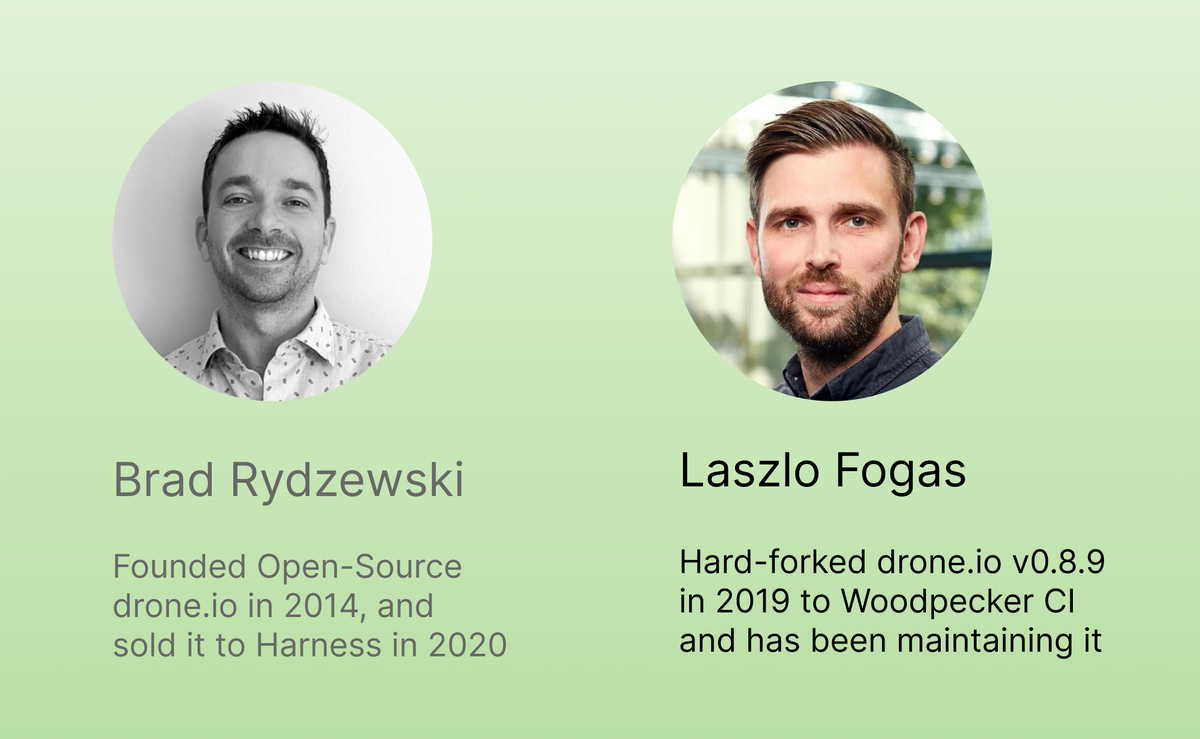
Woodpecker CI originates from Drone CI, a well-known open-source project that was later acquired by Harness. After the acquisition, Drone’s licensing and pricing model changed significantly, making it less accessible for many teams.
Thanks to Drone’s open-source license prior to acquisition, the community was able to fork the project and continue its development independently. This fork became Woodpecker CI.
Today, Woodpecker CI continues to evolve as a fully open-source project, maintaining feature parity with what many teams valued in Drone — without commercial restrictions.
Positioning summary
CI is no longer just a developer convenience.
At scale, it becomes part of your cost structure, security model, and operational risk profile.
For small teams and early-stage products, SaaS CI platforms such as GitHub Actions provide excellent speed of adoption and minimal operational overhead. In many cases, they remain the right choice.
However, as organizations grow, CI usage grows with them:
-
more repositories
-
more pipelines
-
more test matrices
-
more preview environments
-
more automation triggered per commit
At this stage, CI costs become usage-driven, and usage is driven by success. This creates a structural risk where engineering productivity and CI spending are directly coupled to external pricing models and policies.
Open-source self-hosted CI systems remove this dependency.
They offer:
-
fixed and predictable infrastructure costs
-
unlimited build minutes by design
-
full control over execution, secrets, and data
-
immunity to vendor policy changes
Within this category, Woodpecker CI represents a pragmatic middle ground.
It is not a legacy system burdened by decades of plugins and technical debt.
It is not a platform that attempts to own your entire DevOps lifecycle.
It is not tied to a single vendor’s pricing strategy or roadmap.
Instead, Woodpecker CI focuses on doing one thing well: reliably executing CI pipelines on infrastructure you control.
This makes it particularly attractive for:
-
teams operating at scale
-
organizations with strict security requirements
-
companies optimizing for long-term cost predictability
-
engineering teams that value infrastructure ownership over SaaS convenience
Woodpecker CI is not a universal recommendation.
It is a deliberate architectural choice.
But for teams that reach the point where CI is no longer a tool — but infrastructure — it remains a viable, modern, and strategically sound option.
You or your development team might use our practical guide to setup Woodpecker CI on own VPS